
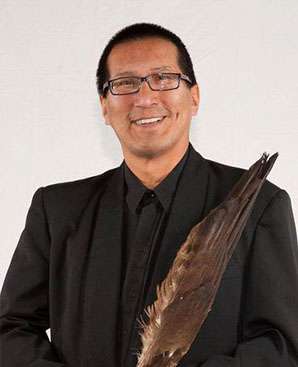
Richard Wagamese
Muskode Pisheke Anaquat (Buffalo Cloud)
1955 - 2017
Richard Wagamese was one of Canada’s foremost Indigenous storytellers and writers for over 35 years. A professional writer since 1979, he was a newspaper columnist and reporter, radio and television broadcaster and producer, documentary producer, and public speaker, and the author of 18 titles from various Canadian publishers.
An Ojibway from the Wabaseemoong First Nation in Northwestern Ontario, his work often mirrored his own life and the childhood trauma he experienced as an intergenerational victim of residential schools and the Sixties Scoop. When Richard reconnected with his birth family at age 26, an Elder gave him the name ‘Muskode Pisheke Anaquat’, which translates to ‘Buffalo Cloud’. The Elder told him it was a storyteller’s name and that his role was to be a teller of stories, a communicator, a keeper of the great oral tradition of his people. That name changed his life. Richard became his name. He sought out stories and storytellers. He sat with them and learned about the role and principles of his people’s storytellers. Then he began to write.
Wagamese was a success in every genre of writing he tried, and won numerous awards and recognition for his writing, including the National Aboriginal Achievement Award for Media and Communications, the Canada Council for the Arts Molson Prize, the Canada Reads People’s Choice Award, and the Writers’ Trust of Canada’s Matt Cohen Award. He was the first Native Canadian to win a National Newspaper Award for Column Writing in 1991, and won the Native American Press Association Award twice and the National Aboriginal Communications Society Award. An anthology of his newspaper columns was captured in The Terrible Summer and published in 1996. He won the Alberta Writers Guild Best Novel Award for his debut novel, Keeper’n Me in 1994 and the Canadian Authors Association Award for Fiction for his third novel Dream Wheels in 2007. One Native Life was one of The Globe and Mail’s 100 Best Books of 2008. His critically acclaimed memoir entitled For Joshua: An Ojibway Father Teaches His Son arrived in 2002, followed by Dream Wheels in 2006, and the novel Ragged Company and his acclaimed and bestselling memoir One Native Life in 2008. He published the follow-up to One Native Life, entitled One Story, One Song in 2011, which won the George Ryga Award for Social Awareness in Literature, and his first collection of poetry, Runaway Dreams, in 2011, followed by The Next Sure Thing in October that same year.
Richard Wagamese is perhaps best known for his last two novels, Indian Horse published in 2012, which was a People’s Choice winner on Canada Reads and winner of the inaugural Burt Award for First Nations, Métis and Inuit Literature, and was made into a feature film that released in April 2018 to box office success, and Medicine Walk, which was published in 2014. Embers: One Ojibway’s Meditations, a collection of personal reflections, was published in 2016, and received the Bill Duthie Booksellers’ Choice Award, and was nominated for a Bill Duthie Booksellers’ Choice Award. Before he died, he was working on Starlight, a sequel to Medicine Walk (2014), which was released as an unfinished novel in August 2018 posthumously along with One Drum: Stories and Ceremonies for a Planet (2019), and Richard Wagamese Selected: What Comes From Spirit (2021).
Sharing his brilliance and inspiration with a whole new generation will mark the next phase of Richard’s creative contribution to the world as four picture books drawn entirely from his published work were sold to Douglas & McIntyre and Tundra Books in 2023. The Animal People Choose a Leader by Richard Wagamese and Bridget George was released in on October 12, 2024. Two additional children’s books are slated to be released including The Inquisitive Raven by Richard Wagamese and Bridget George (Sep 2, 2025) and Canada: We Are the Story by Richard Wagamese and Mangeshig Pawis-Steckley (Mar 3, 2026).
Wagamese wrote for the television series North of 60, and his series One Native Life ran as a radio commentary and newspaper column in both Canada and the U.S., and was a weekly television commentary on CFJC-TV 7 in Kamloops, BC from 2007 to 2010. He also led writing and storytelling workshops in communities across Canada. He was honored with an Honorary Doctor of Letters degree from Thompson Rivers University in Kamloops in June 2010 in recognition of a lifetime achievement in writing and publishing, and was the 2011 Harvey Stevenson Southam Guest Lecturer in Professional Writing at the University of Victoria.
Richard Wagamese passed on March 10, 2017 before he got to witness the adaptation of his novel Indian Horse premiere to a standing ovation at the Toronto International Film Festival. Richard left behind two sons, six grandchildren, his fiancé, three ex-wives, two former partners, nieces, nephews, extended family, friends and colleagues as well as a number of books, published posthumously, that became best-sellers.
Richard Wagamese gave us his life on the page and through his storytelling. His audiences fell in love with his generous, graceful, open heart. From his own tumultuous journey through childhood trauma, racism and substance abuse, and his fight to emerge stronger, Richard forged a path for others, opened doorways to other worlds and brought people together with his words. He was proud and humbled to have the opportunity to bring the story of his people forward. And he deeply believed in the healing power of stories to change the world, one story at a time.
A feature documentary on his life called The Next Chapter is currently in development and his novel Ragged Company has been optioned for development.
“The truth of my life is that I am an intergenerational victim of residential schools. Everything I endured until I found healing was a result of the effects of those schools.”
- Richard Wagamese


"Story is everything. Work only for story's sake, and leave all else to Creator. This is the recipe for success."
- Richard Wagamese (1955 - 2017)
“All that we are is story. From the moment we are born to the time we continue on our spirit journey, we are involved in the creation of the story of our time here. It is what we arrive with. It is all we leave behind. We are not the things we accumulate. We are not the things we deem important. We are story. All of us.
What comes to matter then is the creation of the best possible story we can while we’re here; you, me, us, together. When we can do that and we take the time to share those stories with each other, we get bigger inside, we see each other, we recognize our kinship – we change the world, one story at a time…”
Richard Wagamese (1955 - 2017)